



|
|
|
|
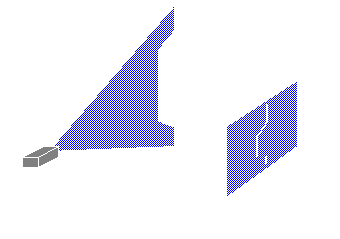
Structured LightFor faithful 3D reconstruction of objects with smooth surfaces, stereo vision techniques rely heavily on the surface texture. However, most industrial objects lack this feature. To overcome this problem the structured light techniques project specific light patterns on the object. The light patterns are distorted by the object surface. These distorted patterns are observed by a camera and then used to compute surface properties. Particularly useful is a set of techniques, known as coded light techniques, that project a sequence of well-defined binary patterns. Within this sequence, time-encoded correspondence information is included.
We use a Graycode sequence to encode row and column information in combination with a device that projects regularly spaced stripes (i.e. sheets of light) on the object.
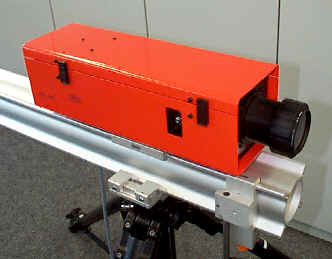
In addition other techniques like phase shift measurements can be used to further enhance the results and achieve sub-stripe accuracy. Our projection device is a LCD stripe projector with a maximum resolution of 640 x 640 lines that can be used to generate arbitrary line patterns (ABW 640 cross).
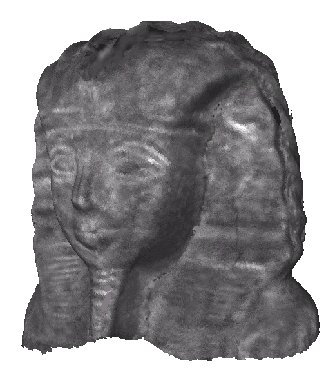
Both the camera(s) and the projector have to be precisely calibrated to get the intrinsic parameters like principal distance, principal point coordinates and distortion. In addition, the relative orientation between the camera(s) and the projector must be determined. Once the corresponding points are known, we can easily compute their 3D coordinates in the sensor coordinate system. Our system is capable of producing up to a few 100,000 triangles within a few seconds. Since the camera is part of the vision system, we also get registered texture images.
One of the main drawbacks of phase shift measurements is there sensitivity to surface intensity variations which cause systematic errors in range measurements. These flaws can be avoided by using a new processing scheme, called line shift processing. |
|
|