



|
|
|
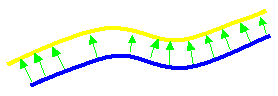
| Registration of Dense Surface MeasurementsTo capture the complete surface of any non trivial object, a number of measurements from different viewpoints are needed. Each individual measurement is given in the sensor coordinate system. The goal of registration is to transform sets of surface measurements into a common coordinate system. In 1992, Besl and McKay introduced the Iterative Closest Point (ICP) algorithm to register two sets of points on almost arbitrary surfaces. ICP is 'a general-purpose, representation-independent method for the accurate and computationally efficient registration of 3-D shapes including free-form curves and surfaces'. Provided that the transform between the two surfaces is approximately known, the original ICP algorithm operates as follows given point set P and surface Q where P is a subset of Q :
This approach will converge to the nearest local minimum of the sum of squared distances between closest points. A good initial estimate of the transformation between point sets is required to ensure convergence to the correct registration.
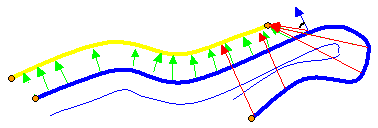
Extensions of this algorithm are now widely used for registration of multiple sets of surface data that are not strict subsets of each other. We have implemented a modified version of the classical ICP algorithm. In particular we use the following criteria to guarantee consistent point matches:
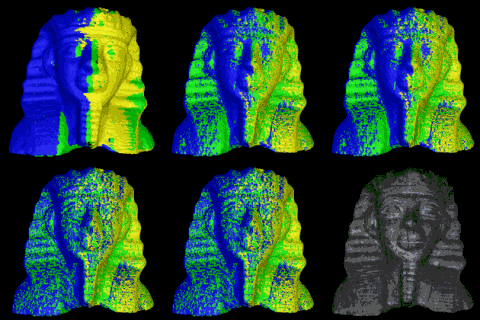
To consider varying accuracy of point coordinates, we have developed a new weighting scheme within the pose estimation process. The approach has proven to be well-suited for high accuracy surface registration.
An algorithm for the simultaneous registration of multiple views considering accuracy information is currently being developed. |
|
|