


Home Up Table of Contents Feedback

Calibration
Stereo Vision Structured Light Calibration Registration Object Recognition


Home
Curriculum Vitae
Research
Publications
Education

Home at ifp

Calibration

One of the most challenging tasks for any vision system is the acquisition of densely measured three-dimensional surfaces.

In order to obtain high accuracy, the systems need to be calibrated, i.e. extrinsic and intrinsic parameters have to be determined.

We are working on the calibration of different types of sensors, ranging from stereo microscopes over digital cameras to structured light projectors.

Example: Calibration of a Structured Light System

We have focused on the comparison of different approaches for the calibration and processing of the coded light system in the past, namely:

  • Polygonal models (z-stage calibration)
  • Photogrammetric calibration.

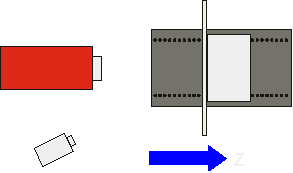
Z-Stage Calibration

  • The Calibration plate is moved in z-direction
  • For each camera pixel and the observed projector line the position in object space is known
  • A polynomial model is fitted to the data
  • 3D-coordinates for arbitrary pixel / phase combinations can be interpolated

Photogrammetric Calibration

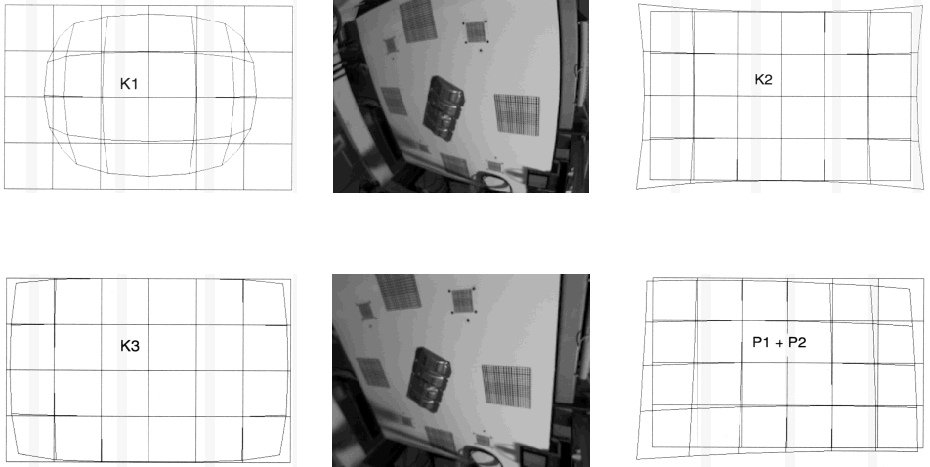
  • Set of additional parameters
    • focal length c
    • principal point coordinates x0, y0
    • radial distortion (K1, K2, K3)
    • decentering distortion (P1, P2)
    • affinity (B1, B2)
  • Projector modeled as an inverse camera
  • Free network bundle adjustment
  • Simultaneous estimation of
    • position and orientation of the camera / projector
    • additional parameters
    • accuracy measures

While polygonal calibration methods do not model the physical process of image formation, the photogrammetric calibration methods determine the parameters of a pinhole camera model and the deviation from the ideal model by introducing additional parameters (APs) like radial or decentering lens distortion.

Since the physical model turned out to be advantageous, we now focus on the photogrammetric calibration and its further improvement and address aspects like:

  • Automation of the calibration procedure
  • Accuracy and reliability
  • Stability and repeatability
 
Previous Home Up Next
Please address questions and comments on this website to: jens.guehring@ifp.uni-stuttgart.de
Last update: 08.08.2000