



|
|
|
| Stereo Vision BasicsStereo Photogrammetry reconstructs the 3D shape of an object, using images which are acquired from different viewpoints. By identifying the same features among these views, the depth of these features can be estimated, provided that the camera parameters are known. Identifying the same features among different views (the correspondence problem) is the main problem in stereo imaging. Intensity based matching can be used as an automated technique to match corresponding regions in different views. The minimization of a least squares merit function yields the position of the matching points (e.g. the region centers) in the image coordinate system.
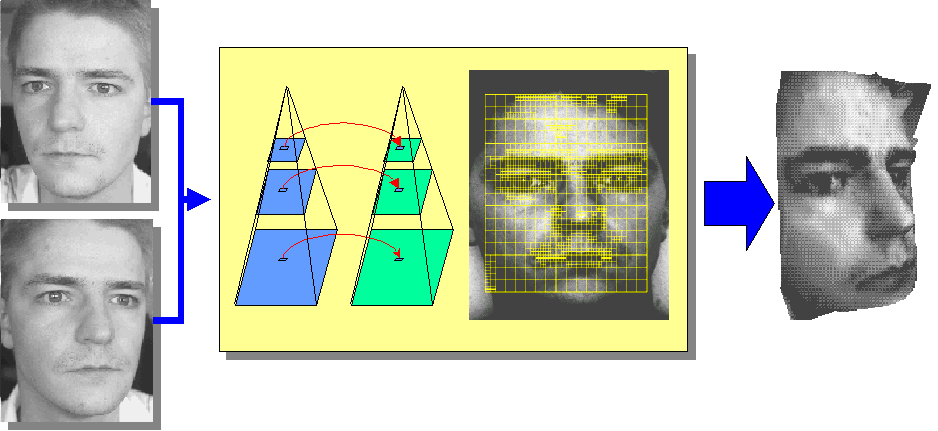
Intensity Based Matching for face reconstruction. The implementation uses image pyramids for robustness and makes use of a quadtree data structure to adapt the level of detail to the image data (courtesy of Claus Brenner). This approach generates an accurate reconstruction of the object that can be further enhanced by image pyramids and epipolar constraints to increase the convergence radius of the least squares process and give a more robust solution. However, if the gray values show only poor variation within homogeneous regions, the reconstructed data is sparse and it is not sufficient to build a 3D model of the object. In many industrial applications, stereo, as a passive vision technique, is not capable of providing a robust and sufficient 3D map of the object. The meaning of passive vision is that there is no control over the the lighting device. Controlling the lighting device enables the vision system to deal with featureless objects by introducing artificial features in the scene. |
|
|